Birdwatching by Water
By Farah McCrate and Leanne Guzzwell
Newfoundland and Labrador is a birdwatching paradise. Over the course of the year, more than 400 species call our province home, from the common to the rare. Watching them is an excellent way to get outside, expand your knowledge, and enhance your wellness. I am a firm believer that when you know things by name, you have more capacity to love them. Love can lead to a greater desire to care for the natural world.
Fortunately for those of us who enjoy paddling, we can combine our favourite paddling activity with the opportunity to birdwatch. We are spoiled for choice here in this beautiful province where some of North America’s most incredible seabird colonies and coastal wildlife can be viewed nesting along 29,000 kilometers of coastline – and that’s just the ocean! Newfoundland and Labrador is also known for a vast network of freshwater resources including lakes, ponds and rivers. These comprise important habitats for many birds and offer prime opportunities to encounter a variety of bird species.
An important point to note is that you do not need to be an expert or have pricey gear to birdwatch. This assumption can dissuade some folks from giving it a try. For some, birdwatching conjures up images of hours of waiting, crouched in uncomfortable positions with a very expensive camera and a paparazzi caliber lens. Sure, those enthusiasts exist and I tip my hat to their dedication and expertise! I do love seeing their hard- won pictures on local Facebook pages – without having to do the work myself!
I consider myself an amateur birdwatcher, perhaps I would call myself an “incidental birdwatcher.” If I’m out doing another activity I enjoy, by land or by water, and I incidentally encounter a bird, I love stopping to listen and look. When I do recognize a bird by song or sight, I get little thrill of pleasure that my knowledge is building. Similarly, when I encounter a species that I don’t think I’ve seen or heard before, I feel a rush of excitement at the prospect of something new. A win-win situation! My point is that you can delve into birdwatching a little or a lot and still get enjoyment from it.
Trying to write an article on birdwatching by water in NL is a very tall order. How could I decide on which birds to feature without feeling like I am doing a disservice to all the other species? One way was to think about the crowd pleasers, another was to think about what paddlers would be most likely to encounter. There are lots of approaches that might be taken to this, so in the end I had to take a deep breath and choose, reminding myself that there are copious excellent resources available for further learning. I have tried to include a fair representation of seabirds and freshwater birds to be inclusive of all types of paddling activity.
Seabird Species
Atlantic Puffin (Fratercula arctica, Alcid Family): While the much-loved Atlantic puffin, our provincial bird, needs no introduction, I could not omit these delightful and clownish little birds. As with many seabirds in NL, their season runs from mid-May to August with peak viewing in June and July.
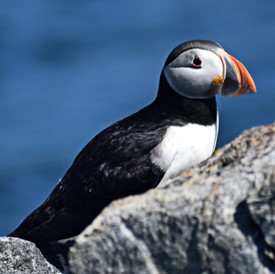
Top viewing locations include the waters around the Witless Bay Ecological Reserve on the Southern Shore and in Elliston on the Bonavista Peninsula. The Elliston site is also particularly good for land viewing. In my experience, it is not uncommon to see puffins while paddling in many of the bays around the Southern Shore, for example Cape Broyle, Ferryland or Bay Bulls. Puffins are highly recognizable by their unique appearance including a triangular orange tipped bill and orange feet. Common NL names include sea parrot, hatchet-bill, or hatchet-face.
Fun fact: Puffins shed the colourful outer parts of their beak in non-breeding season and have darker facial plumage, looking like quite a different bird!
Common and Thick-Billed Murre (Uria aalge and Uria lomvia, Alcid family): Often seen in dense groups on the water or nesting on steep cliffs, common and thick-billed murres are quite similar, but there are some signature ways to tell them apart. Thick-billed murres are jet black in comparison with their black-brown cousins, and have a slightly thicker bill. They have a prominent white line along the mandible (bill). Common murres have a longer, thinner bill. Some of them, though not all, have a fine white line encircling and extending back from the eye; these are referred to as the bridled or ringed morph. This genetic variation is mostly found
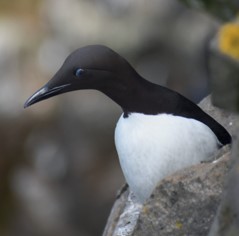
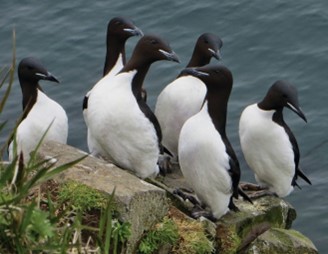
North Atlantic populations. Next time you encounter a murre, impress your friends by correctly identifying it!
Like puffins, murres can be seen in the breeding season on and around the Witless Bay Ecological Reserve, accessible by sea kayak. Another excellent viewing location is the Cape St Mary’s Ecological Reserve, where you can see them from the land as well as the sea. Common NL names for the murre are turr and Baccalieu bird. (Elsewhere they are often called guillemots.)
Fun fact: Murres do not build nests but lay their single, pear- shaped egg on a bare rock ledge. The shape ensures it rolls in a circle rather than off the cliff.
Northern Gannet (Morus bassanus, Sulidae family): The northern gannet is the largest North Atlantic seabird, with a wingspan of 170-192 cm. Adult birds are bright white with black-tipped wings, a buff-coloured head and neck, and a very sharp and pointed blue-grey bill. Their eyes have a blue orbital ring with a light blue-grey iris. They are plunge divers, feeding on small, oily, schooling fish such as mackerel, capelin or herring. There is nothing quite like seeing this large bird transform into a streamlined torpedo before hitting the water. From a kayak at sea level, it is spectacular.
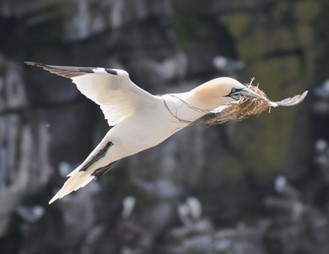
comes alive with nesting pairs. You can see Bird Rock from the land, but it is also feasible to paddle out to Cape St. Mary’s on a day when conditions are good. Leaving from the community of St. Brides and returning by the same route is likely the best option.
The best place to see gannets is the Cape St. Mary’s Ecological Reserve, where they gather in the tens of thousands during the breeding season. Bird Rock, a sea stack where they lay their eggs without fear from animals (including Homo sapiens) on the mainland,
Fun fact: Northern gannets exhibit handedness (or “wingedness”) when hunting, with individual birds demonstrating a consistent preference for rolling to either the left or the right when plunge- diving for prey. Research indicates a roughly 50/50 split in the population between left- and right-winged birds, with a small number being ambidextrous.
Coastal Birds of Prey and Shorebirds
Bald Eagle (Haliaeetus leucocephalus, Accipitridae family): Newfoundland has one of the largest populations of bald eagles in eastern North America. They are often found near coasts, lakes, and large rivers. Easily recognizable as adults, bald eagles have a dark brown plumage on their bodies with a snow-white head and tail. The heads and tails of juvenile bald eagles are brown like the body, not reaching their snowy white colouring until they are 4-5 years of age. Due to their colouring, juvenile bald easgles are some-
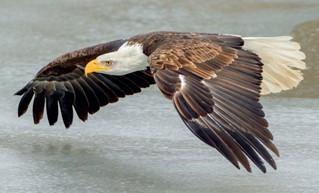
times mistaken for osprey, especially while in flight. Bald Eagles are commonly seen by ocean paddlers almost anywhere in coastal Newfoundland – in Chance Cove it’s almost a sure bet you’ll see more than one. They can also be found inland, when paddling rivers and lakes. While bald eagles on the island of Newfoundland generally remain year-round, in fall and winter some Labrador bald eagles migrate to the eastern United States.
Fun Fact: Rather than doing their own fishing, bald eagles often go after other creatures’ catches. A bald eagle will harass a hunting osprey until the smaller raptor drops its prey in midair, where the eagle swoops it up.
Osprey (Pandion haliaetus, Pandionidae family): Ospreys are a migratory bird, so the best time to view them in NL is from spring to late summer. Like bald eagles, they can be found around coastal and inland waters. An osprey can be identified by its brown back and wings, contrasted with white underparts. The head is white with a broad brown line extending back from the eye; the beak is black and strongly hooked. Ospreys hunt by
hovering 10-40 metres above water. When they spot a fish, they plunge feet first using their talons to grab it. Ospreys can be found in several locations around the province; from a pond paddle in Pippy Park to coastal paddle in Terra Nova Park you may see one hovering overhead looking for its next meal.
Fun Fact: A well-known nesting pair, often referred to as “Beaumont and Hope,” nests on a Newfoundland Power pole near the Virginia Waters Substation on Snow’s Lane. In previous years, Newfoundland Power has set up a NestCam which provides a live stream feed of all the action at the nest. Look out for it this year!
Spotted Sandpiper (Actitis macularius, Scolopacidae family): Spotted Sandpipers are one of the most frequently encountered shorebirds, breeding along rocky shorelines of rivers, ponds, and lakes in Newfoundland during the summer months. They are often seen foraging among rocks and are recognized by the constant bobbing motion their tails and the distinctive dark spotting across their breast and belly during the breeding season. Females build their nests in tall grass to stay hidden from predators, and they lay four large, spotted eggs. By July, spotted sandpiper chicks are hatching, and being a precocial species, they are soon ready to start exploring and eating insects on their own.
Fun Fact: Spotted sandpipers are polyandrous species,
hovering 10-40 metres above water. When they spot a fish, they plunge feet first using their talons to grab it. Ospreys can be found in several locations around the province; from a pond paddle in Pippy Park to coastal paddle in Terra Nova Park you may see one hovering overhead looking for its next meal.
Fun Fact: A well-known nesting pair, often referred to as “Beaumont and Hope,” nests on a Newfoundland Power pole near the Virginia Waters Substation on Snow’s Lane. In previous years, Newfoundland Power has set up a NestCam which provides a live stream feed of all the action at the nest. Look out for it this year!
Spotted Sandpiper (Actitis macularius, Scolopacidae family): Spotted Sandpipers are one of the most frequently encountered shorebirds, breeding along rocky shorelines of rivers, ponds, and lakes in Newfoundland during the summer months. They are often seen foraging among rocks and are recognized by the constant bobbing motion their tails and the distinctive dark spotting across their breast and belly during the breeding season. Females build their nests in tall grass to stay hidden from predators, and they lay four large, spotted eggs. By July, spotted sandpiper chicks are hatching, and being a precocial species, they are soon ready to start exploring and eating insects on their own.
Fun Fact: Spotted sandpipers are polyandrous species, Meaning that females will lay eggs in
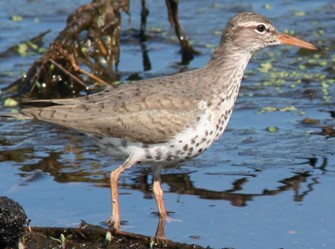
multiple nests, for multiple males. Each male then incubates the eggs he fertilized, and raises the offspring!
Common and Red-breasted Mergansers (Mergus merganser and Mergus serrator, Anatidae family): Mergansers are exceptionally good at catching fish and aquatic invertebrates, due to their serrated bills. They are found during the breeding season in forested habitats, near lakes, ponds, and rivers with dense vegetation. While breeding males of both species have * Editor’s note: Precocial species are those that are physically mature at birth and need relatively little parental care. Altricial species, in contrast, continue to grow and mature after birth, and must be cared for by their parents for longer before they can become independent.
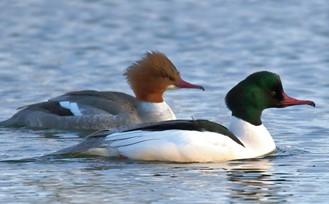
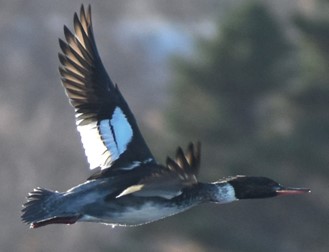
green heads and long slender orange or red bills, the red- breasted males have red eyes and a spiky-looking crest, whereas the common males have dark eyes and a smooth head. Red-breasted females are greyish-brown all over, whereas common females have a brown head and greyish-white body. Both species are precocial, the hatchlings leaving the nest cavity almost immediately. Common mergansers prefer to nest in tree cavities, holes carved out by woodpeckers, or rock crevices; the young leap to the ground shortly after hatching and follow their mother to the water to begin feeding. Red- breasted mergansers, on the other hand, nest on the ground, using dense vegetation to hide their nests from predators.
Fun fact: Both species often engage in brood parasitism, a behavior in which they lay some of their eggs in the nests of other ducks. The host ducks then raise those young, while the biological parent is putting its effort into raising a different brood. Both species are also known to occasionally form creches, where multiple broods combine and are supervised by one or more females.
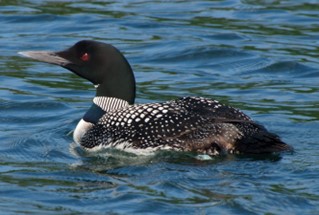
Common Loon (Gavia immer, Gaviiformes family): Common loons are well known for their haunting calls, often heard echoing across ponds and lakes at dusk and dawn. During the breeding months, they have striking black heads with red eyes and a collar of vertical white stripes around the neck. Their backs and wings display a checkered pattern of white spots on
black feathers. Their bodies are adapted for swimming, with their legs positioned far back on their body; this leaves them unable to maneuver well on land. Loons are exceptional divers, highly adapted to pursuing fish underwater, and they can stay submerged for several minutes while hunting. This makes them difficult to relocate after they dive, binoculars, as they may resurface far from where they initially disappeared beneath the surface.
Fun fact: During the summer months, loons may be seen with their chicks or two hitching a ride on their parents’ backs to stay warm and avoid predators.
This list of birds only scratches the surface of what you may encounter during your outdoor pursuits. For those new to birding, give it a try this summer while doing your favourite paddling activity! You’ll be pleasantly surprised to find how rewarding it feels to recognize a species when you see it.
Tips to remember when birding
- Always maintain a respectful distance from bird colonies or nesting areas to avoid
- Never approach nests, eggs, or young, as disturbance can lead to abandonment. .
- Keep voices low and movements calm, to avoid startling
- Pack out garbage, and leave areas as you found
- While snapping pictures, ensure that conditions are safe for both you and the birds.
- Respect private
- When on land, stay on established trails to avoid harming sensitive habitat.
- Report injured or distressed wildlife to our local licensed wildlife rehabilitation organization – The Rock Wildlife You can learn about them at Click Here – their discussion of the challenges of rehabilitating different birds is quite interesting.
Birding Resources
Nature NL offers many resources to help you get into birding. They have a free birdwatching guide with information about all regions of the province, which you can download at:
naturenl.ca/publications. They also have regular guided walks, bird learning nights, and public talks. You can learn more about what they do at https://naturenl.ca.
NatureNL has teamed with the NL public libraries, The Outfitters, and NL Hydro to offer birding backpacks and marine wildlife backpacks that you can check out with your library card. There are both adult and children versions available and they have everything need to get you started including binoculars and bird books. More info at https://naturenl.ca/ nature-backpack-program/ or check with your local library.
The Merlin Bird ID app, produced by the Cornell University Lab of Ornithology is a fantastic tool for beginning and experienced birders alike. It lets you identify birds by either picture or sound. This is a great free resource, at least as good as a bird book, and it doesn’t add any weight to our backpack. Search for “Merlin bird app” on your phone.
Boulder Books publishes a field guide to the birds of Newfoundland – get it from them at https://boulderbooks.ca/ product/birds-of-newfoundland-field-guide/ or at your local bookstore.
Waterford Press, a publishing company based in Florida, produces a folding pocket guide to familiar bird species of Newfoundland and Labrador. Get it from them directly at https://www.waterfordpress.com/newfoundland-labrador- birds.html, or google the guide to find many other vendors.
Bird the Rock offers bird and nature tours of Newfoundland and Labrador; check them out at https://birdtherock.com/
Binoculars are a must if you want to watch birds. As you think about what kind will work best for you, you can see all kinds of reviews at https://www.bestbinocularsreviews.com/.
Remember that if you’re taking them on your kayak, you’ll want ones that are waterproof – and always attach them to your deck!
Farah McCrate is an avid outdoor enthusiast and adventurer, fueled by the reading of many Famous Five books by flashlight as a child. She served as president of of Nature NL for the past three years. She is primarily a sea kayaker but loves a good freshwater paddle as well. She loves being an amateur birder, wild flower IDer, and, in general, learning and soaking up all the information she can absorb. When not enjoying the outdoors, she trained as a health psychologist and epidemiologist and has worked in health care, primarily research and cancer care, for most of her career.
Leanne Guzzwell is passionate about wildlife, conservation, and environmental education. She is the Environmental Education Coordinator at Nature NL and a specialist in seabird ecology and ornithology. She spent over a decade educating the public through hands-on animal programs as the former owner of the Little Rays Nature Centre NL franchise. In her free time, she enjoys spending time with her six year old twins and pets, kayaking, paddleboarding, hiking, birdwatching, gardening and plant identification.
Ebb & Flow Spring 2026